
The announcement probably sounded great.
Your MSP has joined a larger organization. The deal brings more resources, deeper expertise, expanded capabilities, and a stronger future. Everyone is thrilled. Nothing important is going to change.
Then the service got worse.
Tickets sat longer in the queue. Your employees repeated the same issue to one technician after another. Tickets closed before the problem was fixed. The useful service review turned into another chance to sell you something.
Your invoice still arrived on time.
Nobody asked you about the ownership change. You’re just living with it.
Why Is Private Equity Buying MSPs?
Private equity is buying up managed IT for one obvious reason: recurring monthly revenue tied to contracts customers can’t easily escape.
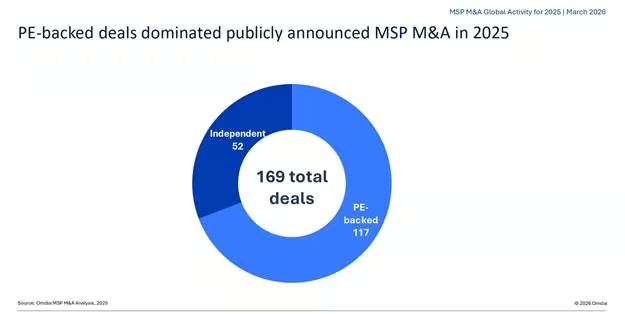
Omdia analyzed 169 MSP-related mergers and acquisitions announced in 2025. Private equity appeared in 69 percent of the deals where investor involvement was disclosed. The pace has continued to increase. Omdia shows 64 global MSP and MSSP acquisitions in the first quarter of 2026, a 73 percent jump from the same period a year earlier, according to Channel Dive.
An MSP owner who has spent decades building a company can sell, take their payout, and hand the difficult parts of running the business to a larger organization. They probably see it as a reward for years of hard work.
You helped create the price the buyer was willing to pay.
Reliable monthly payments made the revenue predictable. Your renewals made the customer base valuable. When the deal closed, your relationship with the MSP became part of what changed hands. Nobody needed your permission.
On the private equity acquisition asset spreadsheet, your business is just recurring revenue.
Why Does MSP Service Get Worse After an Acquisition?
Service often gets worse because the experienced engineers who solved hard problems get pulled into integration work or leave. The help desk was already passing your ticket around before the acquisition. At least a hard problem could eventually reach an experienced engineer who knew how to get past the standard troubleshooting script.
After the sale, that wait can grow even longer. As senior engineers are busy with implementation and cleaning up whatever broke during the transition, they are less available to you. Some techs end up managing larger teams. Others leave instead of spending the next few years being absorbed by one MSP after another.
A password reset still moves quickly, but the accounting application that stops connecting to the server? That ticket still sits in the queue waiting for someone capable of fixing it. The ticket may show plenty of activity during that time. Someone adds a note, changes the status, asks another basic question, or sends an update promising that the issue is under review. Your employee still can’t work.
The monthly report still charts acceptable response times while an employee spent days waiting for a real fix. A ticket that’s been updated five times doesn’t mean it’s been resolved. You know that service declined because you were there before the sale. No acquisition announcement gets to argue with that experience.
Is Private Equity Buying MSPs in Houston?
Yes. Two of Houston’s larger MSPs have taken private equity investment. In June 2026, Houston-based Centre Technologies announced an investment from LightBay Capital while retaining Main Street Capital as an investor. The announcement specifically identified acquisitions as part of the company’s growth strategy.
Houston-based Meriplex announced Vitruvian Partners as its new majority shareholder in 2022 after completing 13 acquisitions since 2018.
Elsewhere in the industry, Evergreen celebrated its 100th MSP acquisition in 2025. The company says its MSPs remain independent under a decentralized model.
Whatever ownership model appears in the announcement, your provider still owes you an answer about what the sale has done to your service. If support is slower, recommendations are harder to trust, or the bill stopped matching the value, the results are already sitting in your inbox and ticket history.
Can You Leave Your MSP Contract After an Acquisition?
Only if your agreement gives you a way out. The contract usually survives the sale. A provider that delivers bad service should lose the customer, which is exactly the consequence a long-term agreement helps it avoid.
Ownership changes. Your support team gets replaced. Tickets move into a centralized queue and nothing works like the service you agreed to buy. You’re expected to keep paying because the contract survived every change that damaged the relationship.
That’s a rotten arrangement.
Read the assignment and change-of-control language before the next renewal notice arrives. Find the cancellation window and any termination fee. Make sure the agreement requires them to hand back your documentation, credentials, and administrative access when you leave. If the contract puts serious money or business continuity at risk, have qualified counsel review it.
By the time you notice the renewal date, the window to cancel is often gone.
How Does JustMSP Protect Clients From a Private Equity Sale?
JustMSP will never be sold to private equity or an outside consolidator. That’s an owner commitment, and we’re willing to put it in writing.
We’re powered by Virtuas, a Houston-founded company that’s still founder-led with no outside investors and is moving toward employee ownership. You can read the whole commitment on our JustMSP About page.
Our service agreement backs it up. If private equity ever buys us in violation of that promise, you can leave without penalty. The language stays in the agreement even if the people who made the promise aren’t around anymore.
Virtuas is a Certified B Corporation and a Public Benefit Corporation. While that designation does not by itself stop a company from being sold, we’re making the commitment ourselves.
JustMSP is also month-to-month service. You can choose annual billing for a lower rate, but our full managed service doesn’t require a long contract.
You should stay because we keep earning it.
What Should You Ask a New MSP About Ownership?
Every decision that made your service worse was made by someone you never met, at a company you didn’t choose.
You found that out the hard way. The good news is that it’s a question you only have to get wrong once. When you go looking for the next provider, ask who owns the company and what happens when the founder wants out. Then ask the real question: how long do they want you to commit?
While you can’t control future changes, what you can control is whether that change costs you anything. A provider confident in its service will earn your business every month instead of every 3 to 5 years.
The best protection against the next acquisition isn’t a better contract. It’s not needing one.
Frequently Asked Questions
Can my MSP be sold without telling me?
Yes. An MSP can change owners without asking its customers, and your contract usually moves with it. Check the assignment and change-of-control language in your agreement to see what rights you have when ownership changes.
Does a private equity acquisition always make MSP service worse?
Not always. Some acquirers say their MSPs keep operating independently. The best measure is your own experience: compare response times, ticket history, and recommendations from before and after the sale.
How common are private equity acquisitions of MSPs?
Very common. Omdia found private equity involved in 69 percent of 2025 MSP deals where investor involvement was disclosed, and first-quarter 2026 acquisitions were up 73 percent from a year earlier.
What contract terms protect me if my MSP is acquired?
Look for a right to exit without penalty after a change of control, a clear cancellation window, reasonable termination fees, and a requirement to hand back your documentation, credentials, and administrative access when you leave.
Can JustMSP be sold to private equity?
No. JustMSP has committed in writing that it won’t be sold to private equity or an outside consolidator. If that ever happens, our service agreement lets you leave without penalty.